
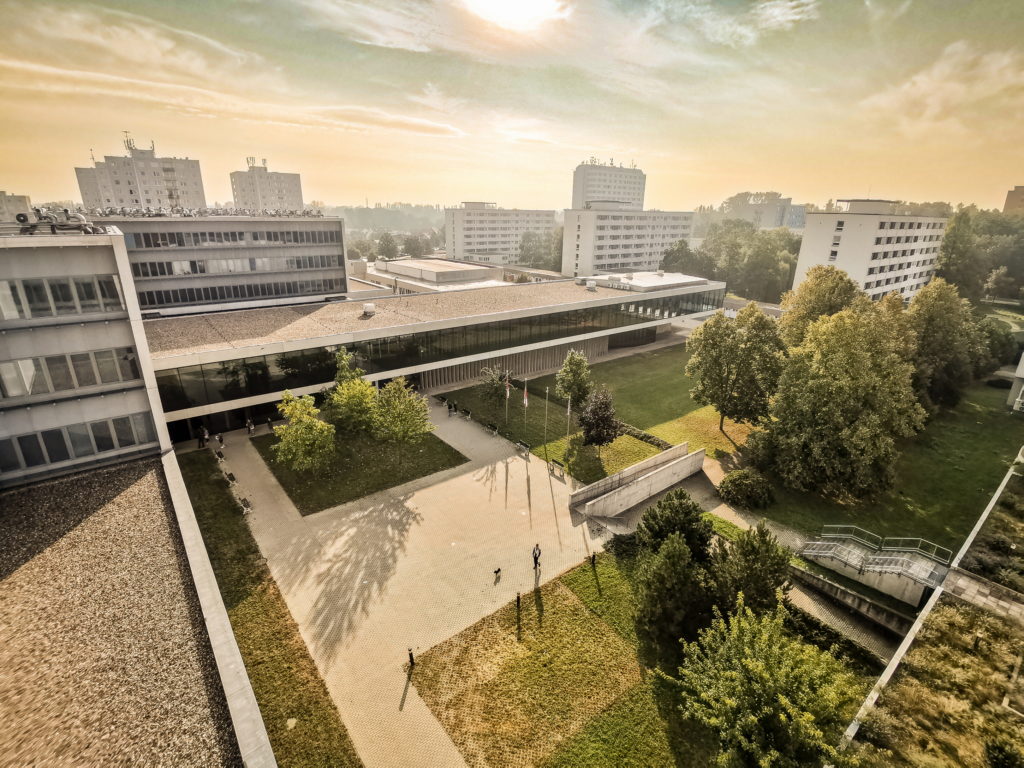
To continue our exploration of the partners of FunctiGlass, let’s talk about the University of Pardubice. This well-known institution started as a chemical school and developed into a full university in the 1990s. The link between chemical studies and Pardubice comes from a long way back in history.
In fact, the city of Pardubice is located in the eastern Bohemia region of the Czech Republic, an area that was already deeply integrated into commercial exchanges some centuries ago. Already in 1778, a local company started to produce sulphuric acid to fulfil local needs.
It was established in the town of Velká Lukavice (modern-day Lukavice in the Czech Republic) and became the cradle of the Bohemian chemical industry. Operating within the mining estates of the aristocratic Auersperg family, this pioneering facility specialized in the mass production of sulfuric acid and fuming sulfuric acid, better known as oleum. The production method relied on local pyritic shales, which were weathered for months to oxidize before being heated in clay retorts above 720 °C; the resulting sulfur trioxide gas was then absorbed into water to yield highly concentrated acid. This innovatively refined product, universally celebrated as « Bohemian oleum, » grew into a vital strategic commodity that fuelled the textile and manufacturing sectors across Europe — particularly in Great Britain and Germany — throughout the 19th century.
No surprise, then, that the nearby city of Pardubice grew out of this local industrial environment, and that it is today one of the best-known innovation hubs in Europe. The University of Pardubice is one of the partner universities Functiglass.
FunctiGlass — « Structured functional glasses for lasing, sensing and health applications » — is the MSCA Doctoral Network (project 101169415) funded under Horizon Europe and coordinated by the CNRS. The consortium brings together almost 20 academic and industrial partners from different countries, uniting leading universities and research institutes with companies in optics, photonics and advanced manufacturing. Its ambition is to develop next-generation glass-based materials for three high-tech sectors: light sources (lasing), sensors, and biological/health applications. Through a joint, double-degree doctorate built on very close academia–industry cooperation, FunctiGlass trains 11 doctoral candidates, preparing them to become future leaders in glass science, especially in nano- and micro-structured glass-based materials.
The University’s participation is embodied by Prof Němec, who also serves as Dean of the Faculty of Chemical Technology. He completed his doctoral studies in Chemistry and Technology of Inorganic Materials at the University of Pardubice in 2002 and was appointed Associate Professor in Inorganic Chemistry in 2006. In 2015, he became full professor in the field of Chemistry and Technology of Inorganic Materials. His research focuses on solid-state and amorphous materials — in particular chalcogenide and oxide thin films — and on advanced deposition techniques such as radio-frequency magnetron sputtering and pulsed laser deposition. His team’s work covers photoinduced phenomena, ultrafast nonlinear optical response, rare-earth-doped films, and chalcogenide glasses for mid-infrared and telecom applications. Within FunctiGlass, he shares this expertise in thin films fabrication and characterization.